
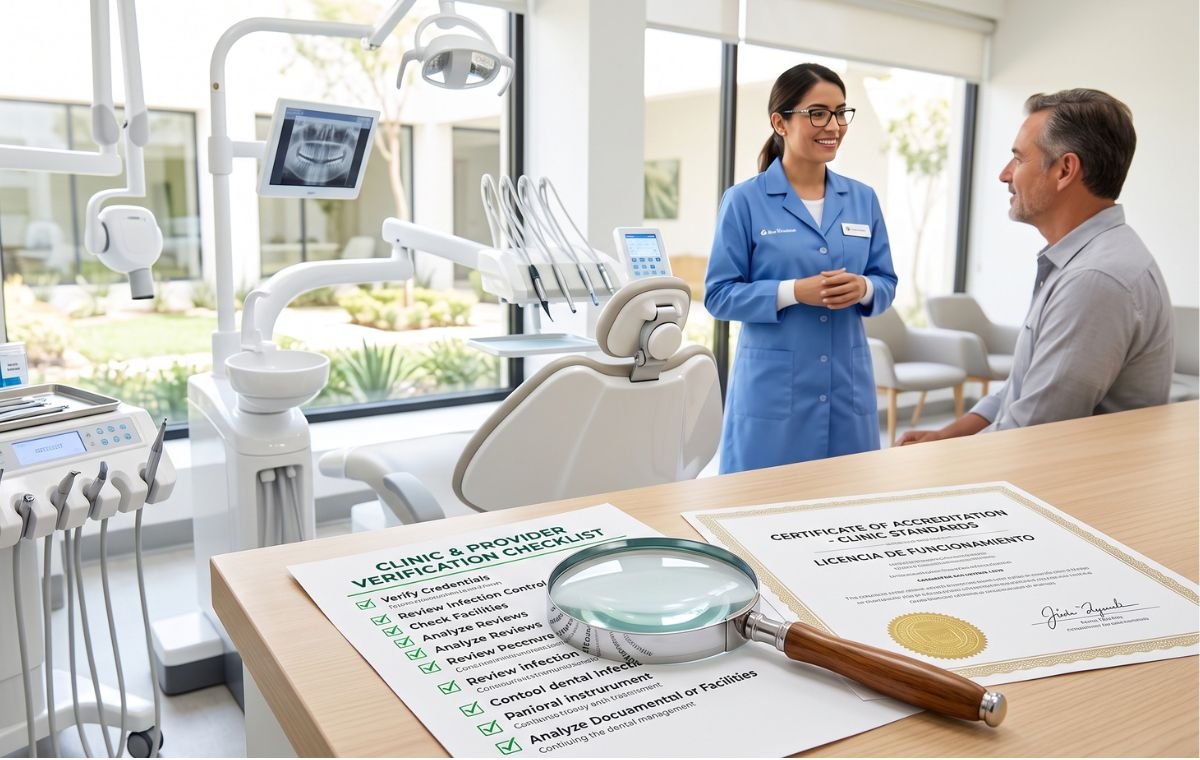
For many U.S. patients, the first question about getting dental care in Mexico is not about price.
It is:
It is a reasonable question.
If you are considering traveling across the border for dental treatment, you are making a decision that involves more than choosing a lower price. You are choosing a dental professional, a clinic, a treatment plan, a payment process, and a way to manage your care while you are away from home.
The most honest answer is that there is no simple yes-or-no answer to whether dental care in Mexico is safe.
The level of risk can depend on the specific provider, facility, treatment, infection-control practices, communication, travel planning, and follow-up arrangements. The CDC specifically notes that the risks associated with medical tourism depend on the destination, facility, and professional providing the care.
So instead of asking only:
a better question is:
That is the purpose of this guide.
Is Dental Care in Mexico Safe?
Dental care in Mexico can be a reasonable option for some U.S. patients, but safety should be evaluated at the provider and clinic level, not assumed simply because treatment takes place in Mexico.
Dental care is actually one of the most common forms of medical tourism among U.S. residents. In a CDC-supported population study, Mexico was the most common international destination among reported medical tourism trips, and dentistry accounted for 55% of the treatments reported.
That does not mean every dentist or clinic offers the same experience.
It means the decision deserves the same kind of careful evaluation you would use when choosing healthcare anywhere.
The CDC recommends that people considering medical tourism research the qualifications of healthcare professionals and the credentials of the facilities where treatment will occur. It also warns that healthcare practices, regulations, and enforcement can differ between countries and facilities.
For a U.S. patient, that makes verification an important part of the decision.
Why Are U.S. Patients Concerned About Dental Care in Mexico?
The concerns are understandable.
When you receive treatment outside your home country, you may be less familiar with:
There is also a practical concern:
These questions do not mean that cross-border dental care is automatically unsafe.
They mean that patients should understand what they are choosing before they commit.
Different Healthcare Systems
The United States and Mexico have different healthcare systems, regulations, and professional oversight structures.
The CDC notes that healthcare professionals in other countries may not be subject to the same licensing requirements, certification, or oversight that patients may be accustomed to in the United States.
That is why it is not enough to assume:
Or:
Instead, ask:
What Makes Cross-Border Dental Care Safer?
No healthcare decision is completely risk-free.
But patients can take steps to become better informed.
A useful framework is:
1. Verify the provider
Know who will perform your treatment.
2. Research the clinic
Understand where treatment will take place and what information is available about the facility.
3. Understand the treatment
Make sure you understand what the dental professional is proposing.
4. Ask about infection control
Patients should be comfortable asking reasonable questions about sanitation and infection prevention.
5. Clarify communication
Know how you will communicate with the provider if you have questions.
6. Understand payment
Know who you are paying, what you are paying for, and what happens if plans change.
7. Have a follow-up plan
Know what happens after treatment and who you can contact if you have questions or concerns.
This is not about eliminating every possible risk.
It is about **reducing avoidable uncertainty before you commit.
How Do You Verify a Dentist in Mexico?
One of the most important steps is identifying the professional who will actually provide your treatment.
Before booking, consider asking:
The CDC specifically recommends checking the qualifications of the healthcare professional and the credentials of the healthcare facility before traveling for medical care.
Don't rely on reviews alone.
Online reviews can be useful as one source of information, but they should not replace verification.
A five-star review does not tell you everything about:
Reviews can be part of your research. They should not be your entire research process.
What About Infection Control?
This is one area patients should take seriously.
The CDC's current Mexico traveler guidance specifically advises people receiving medical or dental care to make sure equipment is disinfected or sanitized.
That does not mean patients need to become infection-control experts.
It means you should feel comfortable asking reasonable questions before treatment.
For example:
A clinic should be able to address reasonable questions about its procedures.
The CDC has also documented a serious outbreak involving highly drug-resistant Pseudomonas aeruginosa among U.S. medical tourists who underwent surgery in Tijuana. The investigation identified infection-control lapses at one facility and emphasized that infection-control standards and regulatory practices can vary by country and facility.
That investigation involved surgery, not routine dental care, so it should not be presented as evidence that dental clinics in Mexico generally have a particular infection risk.
Its broader lesson is more useful:
Patients should not assume that every healthcare facility follows identical infection-control practices.
Ask questions. Verify what you can. Understand where your care will take place.
What Are the Risks of Dental Tourism?
The CDC identifies several categories of potential complications associated with medical tourism, including infections, antimicrobial resistance, problems related to continuity of care, and difficulties obtaining follow-up care after returning home.
For dental patients, relevant considerations can include:
Infection
Any invasive healthcare procedure can involve infection risk.
Treatment complications
No dental procedure is guaranteed to have a complication-free outcome.
Communication problems
Language or communication difficulties can make it harder to understand instructions or communicate concerns.
Follow-up difficulties
A patient may have to coordinate additional care after returning to the United States.
Unexpected costs
A change in circumstances can result in additional expenses.
Travel considerations
Travel itself adds another layer of planning around appointments and recovery.
The important point is not to become alarmed.
It is to recognize that cross-border care requires planning beyond the appointment itself.
What Happens If You Have a Problem After Treatment?
This is one of the most important questions to ask before receiving treatment.
The CDC recommends that medical tourists plan for follow-up care before traveling and understand how they will access healthcare if complications occur after returning home.
Before your appointment, consider asking:
You should also keep copies of relevant:
If you need care after returning home, tell your U.S. healthcare provider about your recent travel and treatment.
The CDC's Mexico travel guidance also recommends planning ahead for healthcare needs while traveling and knowing where you can obtain care if necessary.
Does Distance Affect Dental Care Safety?
It can affect coordination and follow-up, even though distance by itself does not determine clinical safety.
Consider two patients.
One lives near the U.S.-Mexico border and can return to the same region relatively easily.
Another lives several states away and needs to fly to Mexico for treatment.
Their logistical situations are very different.
For a border patient, cross-border dental care may involve:
U.S. home → border → Mexican clinic → border → U.S. home
For a long-distance medical tourist, the journey may involve:
U.S. airport → Mexico → accommodation → clinic → recovery → return flight → home
The farther a patient travels, the more important advance planning may become.
This is one reason we believe it is useful to think about cross-border dental care separately from the broader concept of dental tourism.
What About Dental Insurance and Paying for Care in Mexico?
Do not assume your U.S. insurance will work the same way across the border.
The U.S. Department of State advises travelers that U.S. government programs do not pay medical bills abroad and that U.S. health insurance may not cover care outside the United States. It also notes that many Mexican healthcare providers require payment or a deposit before services are provided.
Your specific dental insurance policy may have its own rules, so confirm coverage directly with your insurer.
Before paying a provider, understand:
Payment should be part of your due diligence—not an afterthought.
10 Questions to Ask Before Choosing Dental Care in Mexico
Before you commit, consider asking these questions:
1. Who will perform my treatment?
Make sure you know the professional responsible for your care.
2. What are the provider's credentials?
Ask for information you can verify.
3. Where will my treatment take place?
Know the clinic or facility where your appointment will occur.
4. What treatment is being proposed?
You should understand the treatment being discussed by the dental professional.
5. What is included in the quoted price?
Clarify what the price covers and what may be additional.
6. What should I know about infection control?
Ask reasonable questions about sanitation and equipment.
7. How will communication work?
Know who you can contact if you have questions.
8. What happens if the treatment plan changes?
Understand what happens if additional treatment becomes necessary.
9. What happens after treatment?
Ask about follow-up and documentation.
10. Who handles administrative questions?
Know who to contact for scheduling, payment, logistics, or other non-clinical questions.
These questions do not guarantee a particular outcome.
They simply help you make the decision with more information.
Can a Dental Care Coordinator Make the Process Safer?
A coordinator cannot eliminate clinical risk.
It is also important not to confuse coordination with clinical care.
Good coordination can, however, help organize the administrative side of a cross-border journey.
That may include:
The purpose is not to replace the dental professional.
It is to help the patient navigate the process around the clinical appointment.
What Is NABA's Role?
This distinction is central to how NABA Management Services is designed.
NABA does not diagnose patients, prescribe treatment, or determine which dental procedure a patient needs.
Those decisions remain between the patient and the independent dental provider.
NABA's role is on the administrative and coordination side of the journey.
That can include helping coordinate appointments, communication, documentation, logistics, and payment administration.
The goal is to help make the process more organized and transparent—not to tell a patient what clinical decision to make.
That separation matters.
Your dental care is a clinical decision. Your journey around that care can be coordinated.
Dental Care in Mexico Safety Checklist
Before booking, use this simple checklist.
PROVIDER
☐ Do I know who will perform my treatment?
☐ Have I reviewed information about their credentials?
CLINIC
☐ Do I know where my treatment will take place?
☐ Have I researched the facility?
TREATMENT
☐ Do I understand the treatment being proposed?
☐ Have I had the opportunity to ask questions?
INFECTION CONTROL
☐ Have I asked reasonable questions about sanitation and equipment?
COMMUNICATION
☐ Do I know who to contact if I have questions?
PAYMENT
☐ Do I know who I am paying?
☐ Do I understand what the payment covers?
TRAVEL
☐ Have I planned transportation and timing?
FOLLOW-UP
☐ Do I understand what happens after treatment?
☐ Do I know what records and documentation I will receive?
Final Takeaway
So, is dental care in Mexico safe?
There is no responsible way to answer that question with a blanket “yes” or “no.”
The more useful question is:
What do you know about the specific provider, clinic, treatment, payment process, travel arrangements, and follow-up plan you are considering?
Mexico is a major destination for U.S. medical tourism, and dental care is a significant part of that activity.
But the existence of a large cross-border dental market does not mean every provider or clinic should be treated equally.
Do your research.
Ask questions.
Verify what you can.
Understand the financial and logistical side of the journey.
And make clinical decisions directly with a qualified dental professional.
Don't just ask whether it's safe. Ask what you've verified.
That is a much better starting point for an informed cross-border dental decision.
Frequently asked questions
Is dental care in Mexico safe?
It can be, but there is no universal answer. The risks associated with healthcare abroad can depend on the provider, facility, treatment, infection-control practices, communication, and follow-up arrangements. The CDC recommends researching the healthcare professional and facility before traveling for care.
Is dental tourism in Mexico safe for Americans?
U.S. patients should evaluate the specific provider and facility rather than assuming that treatment is safe or unsafe simply because it takes place in Mexico. Patients should also plan for payment, travel, and follow-up care.
How do I verify a dentist in Mexico?
Start by identifying the professional who will perform your treatment and researching their credentials and experience. The CDC recommends checking healthcare professional qualifications and facility credentials before medical tourism.
How do I know if a dental clinic in Mexico is legitimate?
Research the clinic and the professional who will provide your treatment. Ask clear questions about the facility, treatment, payment, infection-control practices, and follow-up. Do not rely exclusively on online reviews.
What are the risks of dental tourism?
Potential risks can include infection, complications, antimicrobial resistance, communication problems, continuity-of-care challenges, and difficulties obtaining follow-up care. The level of risk depends on the specific circumstances.
What happens if something goes wrong after dental treatment in Mexico?
Before treatment, understand how follow-up will work and who you should contact. Keep copies of your treatment records and payment documentation, and tell your U.S. healthcare provider about treatment received abroad if you need care after returning home.
Does U.S. insurance cover dental care in Mexico?
Coverage depends on your individual insurance plan. Do not assume that your U.S. coverage applies internationally. Confirm the details directly with your insurer before treatment.
Is dental care in Mexico regulated?
Mexico has its own professional and healthcare regulatory systems, but requirements and oversight can differ from those in the United States. Patients should verify the specific provider and facility rather than assuming U.S.-equivalent oversight.
What should I ask a dental clinic before treatment?
Ask who will perform the treatment, what their credentials are, where treatment will take place, what is being proposed, what is included in the price, how communication works, how payment works, and what the follow-up process will be.